Posted on Jul 30, 2026 by John W. Krysko
Spiritual Surrender
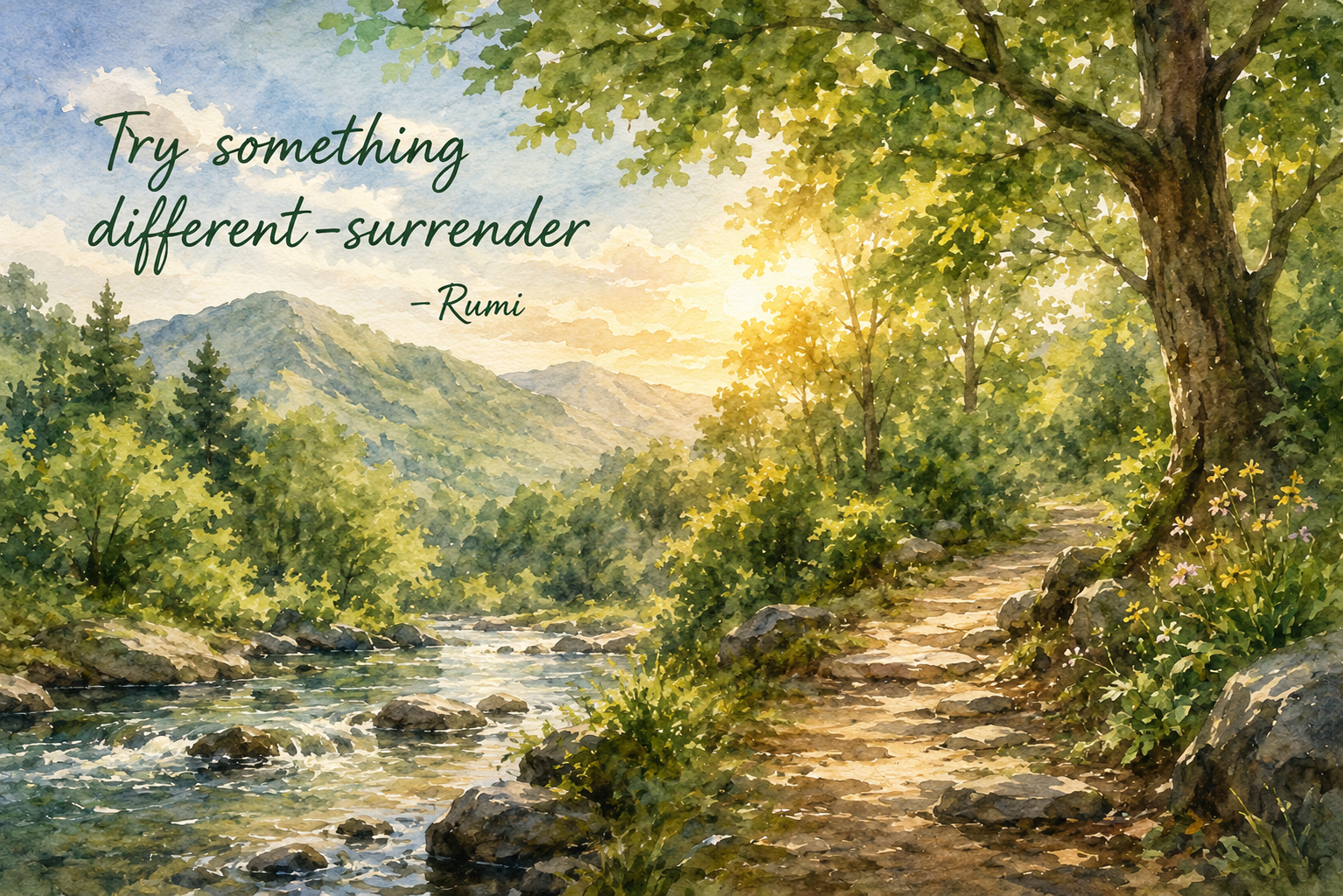
“Try something different-surrender” Rumi, Persian poet 1207-1273
Rumi, the sublime Sufi poet offers us another option as a mode of being-in-the-world-letting go to Spirituality. The Western world has overemphasized the importance of Doing” to the point of putting the inner life on the “Endangered Species” list.
“The world is too much with us; late and soon,
Getting and spending, we lay waste our powers;
Little we see in Nature that is ours;
We have given our hearts away, a sordid boon!” William Wordsworth 1770-1850
Wordsworth captured this exquisitely 225 years ago…and little has changed in the intervening time. I particularly resonate with the idea that we have “given our hearts away”. This dis-ease is not solely mental or emotional- it has ensnared and debilitated our heart, our very soul. So, what does the Divine Physician prescribe?
For millennia, the burden of providing the Spiritual Medicine has fallen to the writers, artists, musicians, philosophers, religious leaders and spiritual masters. Models of true Spiritual Excellence and Enlightenment have long shone the Way, but what is the opportunity for today? What are the challenges? What are the Spiritual Processes for this 21st century?
“If our Surrender can move the hand of God, imagine what our cooperation can do.” Andrena Sawyer, contemporary author, business consultant and ministry leader.
Andrena points the way for me, as true Spiritual Surrender does necessitate our involvement. It is more than just turning things over to some (oft vague) Divinity.
“To be is to do”. Socrates, 469-399 BC
“To do is to be”. Friedrich Nietzsche, 1844-1900
“Do Be Do Be Do”. Frank Sinatra (as per Kurt Vonnegut)
So…where to start with this process…where to turn? Perhaps we can learn from the great spiritual masters and teachers we call “Ballroom Dancers”.
Imagine that the answer to understanding this ages-old dilemma of doingness versus beingness has literally been right at our feet. Imagine life not as a struggle, but as a dance…
In Hinduism, the divine dance of Lord Shiva, known as the Tandava or his form as Nataraja (Lord of the Dance), symbolizes the continuous cosmic cycle of creation, preservation, and destruction. In this iconic representation, Shiva’s movements embody the rhythm and pulsing energy of the universe. Modern physics is starting to catch up.
The parallel between Shiva’s dance and the dance of subatomic particles was first discussed by Fritjof Capra in an article titled “The Dance of Shiva: The Hindu View of Matter in the Light of Modern Physics,” published in Main Currents in Modern Thought in 1972. Shiva’s cosmic dance then became a central metaphor in Capra’s international bestseller The Tao of Physics, first published in 1975 and still in print in over 40 editions around the world.
A special plaque next to the Shiva statue at CERN (the Swiss-based laboratory for particle physics) explains the significance of the metaphor of Shiva’s cosmic dance with several quotations from The Tao of Physics.
More recently, Fritjof Capra explained that “Modern physics has shown that the rhythm of creation and destruction is not only manifest in the turn of the seasons and in the birth and death of all living creatures, but is also the very essence of inorganic matter,” and that “For the modern physicists, then, Shiva’s dance is the dance of subatomic matter.”
So, how exactly can a metaphor of “Dance” resolve the (apparent) dichotomy between “Doing and Being”? Having spent many the delightful day (and night) learning ballroom dancing, all was made clear. The key to successful dancing lies in the mysteries of “Leading” and “Following”. As a man I quickly learned that the key to successful leading was not found in pushing, directing, or forcing, but rather in listening, responding, engaging, and allowing.
The “listening” involves not just hearing the music, but listening to my heart center, and that of my partner. The “responding” was feeling my body (and heart) urge a response. “Responding”, of course, simply was having feet (and legs and arms) move with the music. Finally, the “allowing” is to be so at one with the music, myself, AND my partner that we just moved together, as one. It was and is a most amazing spiritual practice, (and is certainly cheaper than therapy).
Now, not all of us are given to be erstwhile Fred Astaires or Ginger Rogers. We can however take to heart the basic premises of “the Dance” and we can incorporate the principles into our daily lives and spiritual practices. The active AND passive elements can be combined and integrated through:
- (Divine) Listening- This simply means the practice of dropping into Spirit through the Art of Listening. Practice slowing down through whatever practice calls you and then go into your heart space and hear what sound/thought/feeling emerges. Try to capture it as a Sound.
- (Spiritual) Responding- Allow yourself to be open to what your HeartMind is asking of you. (Go to our website for classes and ideas about the HeartMind).
- (Meta-personal) Engagement- Begin the process of following through…only through playing(dancing) our part can the Divine truly manifest.
- (Personal) Allowing- Let the music play, your body (and mind and emotions) respond, and “work” at removing the resistances to let Spirit flow though.
The final phase of Spiritual Surrender is in Enjoyment and the act of Gratitude (and opportunity for Service to others).